AI coding tools are great. Most of them. For some things.
The category is real and the tools are legitimate. They are also remarkably similar in the one way founders keep discovering at the worst possible moment: complex production applications do not fit in a prompt thread. Here is the honest landscape.
The category in one paragraph. AI coding tools let a founder describe a component and watch it render. That is a genuine unlock - until the product needs three user roles, a payments integration, a compliance audit trail, and a database that survives the fifth prompt. For complex applications, every tool in the category hits the same wall at roughly the same point. Creatr is not in the same category: it is a managed development service that ships the whole application, not a code-generation surface the founder operates.
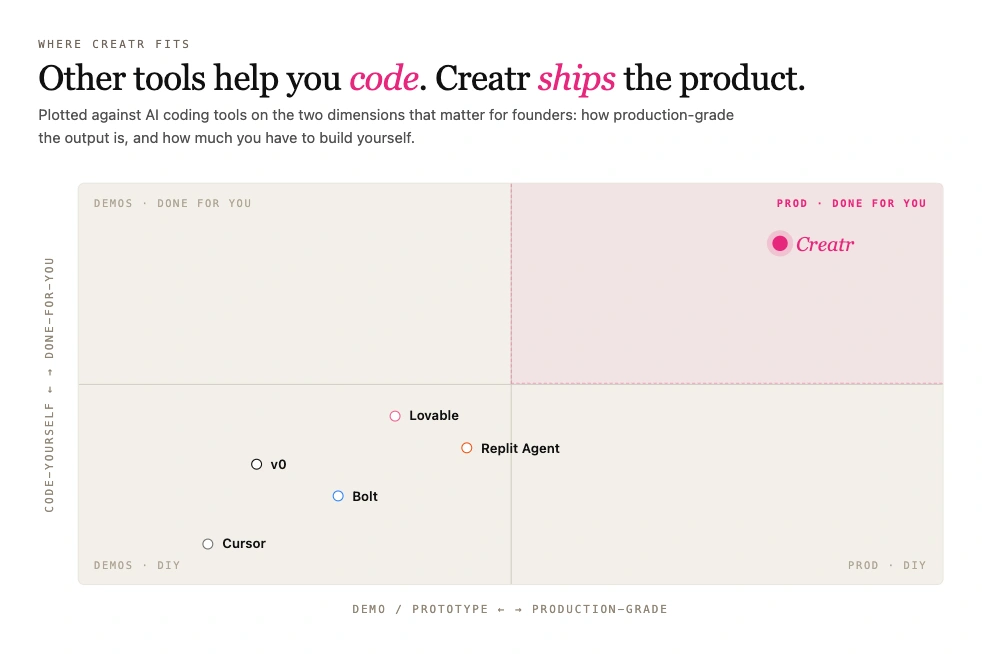
Two axes, one wall
The category splits cleanly along two axes, and most of the confusion about which tool to pick goes away once you see them drawn.
The horizontal axis runs from prompt-loop to structured execution. Prompt-loop tools rebuild context every session - the summary of what you did last time is fed back in as a compressed memory, and the tool works from whatever that memory now looks like. Structured-execution tools work against a persistent document - a specification, a plan, a resolved architecture - that does not drift. Both approaches are valid; they serve different jobs.
The vertical axis runs from component-by-component to full-stack-at-once. Component tools generate one visible thing at a time - a button, a form, a dashboard screen. Full-stack tools generate the whole application in one pass: database, auth, backend, frontend, integrations, deployment, all shipped together.
Bolt, Lovable, and Replit Agent sit in the prompt-loop, partial-stack quadrant - they are brilliant at the thing they do, and they rebuild context every session. Cursor sits in the prompt-loop, developer-owned-stack quadrant; the developer carries the architecture and Cursor accelerates the typing. v0 sits in the single-turn, component corner - it generates one polished component at a time, which is exactly what it is sold as doing. Creatr sits alone in the structured, full-stack quadrant: the spec is persistent, the build is full-stack, and the shipped artifact is a production application on independent infrastructure.
This is not a value judgment. Different quadrants serve different jobs. The point of drawing the map is to stop asking "which tool is best" and start asking "which quadrant does my project actually live in".
Which tool for which job
The honest matrix. For each row, the right tool is named - sometimes it is not Creatr, and that is fine. Founders pick better when the recommendation is truthful.
| If you are... | Start with |
|---|---|
| Building a landing page or marketing site | v0 (components) or Bolt (quick single-session builds) |
| Prototyping a UI to validate a design idea | Lovable - best-in-class UI polish |
| Learning to code, or building something simple | Bolt - fastest feedback loop |
| An experienced developer wanting 3× speed | Cursor - the IDE that works |
| Exploring a stack you have not used before | Replit Agent - broad-stack assistant |
| Building a data-driven app you will operate yourself | Bubble - if platform lock-in is an acceptable trade |
| A marketing site, with the product built elsewhere | Webflow - keep the app separate |
| Internal tools for a trusted team | Retool - until external users log in |
| A founder with a spec for a production app | Creatr |
The pattern: every row except the last has a tool-category answer, because every row except the last is a job the tool category is good at. The last row is a shipped application on a deadline - which is a service shape, not a tool shape. That is the job Creatr is for.
AI coding tool comparisons
Creatr vs Bolt →
Bolt is great for a session. Production applications span sessions. Every session rebuild risks regenerating what the last session committed - which is why the ICP has found themselves debugging a code base that no longer matches the one they shipped yesterday.
Creatr vs Lovable →
Lovable is best-in-class at components. Below the component layer - database, auth, integrations - is the founder's problem. Creatr ships the whole thing, production-configured, in 24 hours.
Creatr vs Cursor →
Cursor is the AI IDE for developers. The ICP does not have one. For non-technical founders, Cursor is a better code editor, not a shipped product.
Creatr vs v0 →
v0 gives you polished React components. Creatr gives you a deployed application with those components wired to a real backend.
Creatr vs Replit Agent →
Replit Agent is honest - it asks which auth library you want mid-build. The ICP cannot answer. Creatr pre-decides by translating product requirements into architecture choices before any code exists.
No-code and platform comparisons
The tools above generate code. This next group is a different category: no-code and low-code platforms you operate yourself - a visual full-stack builder, a website tool, an internal-tool builder. They are not in the AI-coding-tool quadrant, but they reach the same production wall from the other side. You do not run out of prompt context; you run out of platform, and you end up owning a subscription rather than code. These comparisons cover where each one genuinely fits and where it stops.
Creatr vs Bubble →
Bubble is the most capable visual full-stack builder without code. The trade is Workload Unit pricing that spikes during debugging, no source code export, and a performance ceiling on shared infrastructure. Creatr ships a production app as code you own.
Creatr vs Base44 →
Base44 had the strongest structured-data instinct of the AI builders - then Wix acquired it and the roadmap shifted toward Wix. Creatr delivers the owned application without a vendor roadmap deciding its future.
Creatr vs Webflow →
Webflow builds beautiful websites, not applications - no database for user data, no server-side logic, and no native auth after the January 2026 Memberships sunset. Creatr builds the product that lives behind the login.
Creatr vs Retool →
Retool is excellent for internal tools and dangerous the moment an external customer logs in. Creatr builds the customer-facing product, with auth and security designed for the public internet rather than a trusted team.
FAQ
Which AI coding tool is best for complex production apps?
None of the AI coding tools compared here is built for full production applications; they are built for specific parts of the stack (UI, code editing, component generation). The no-code platforms - Bubble, Webflow, Retool - are full products in their own right but come with lock-in, platform ceilings, or a category mismatch. If you need a full application with multiple user roles, third-party integrations, and production deployment delivered as code you own, a managed service like Creatr that ships the whole stack is a better fit than any single tool here.
Can I build a CRM with Bolt or Lovable?
You can start. A single-role CRM with generic auth and basic Stripe is within reach. A CRM with sales/operations/admin roles, different data visibility per role, integration with your email provider, and a migration path from an existing spreadsheet - that is where vibe-coding tools typically stall. See the Hoversight REMS case study for an example of the complexity where this matters.
Is "AI coding" even a real category, or is it just Claude and GPT with a UI?
It is a real category. The UI layer, the stack opinions, and the integration surface each tool builds on top of Claude/GPT are the product. The fact that all of them use the same underlying models is why their limitations are remarkably similar: they inherit the same context-window constraints. Tools that succeed at complex production applications address this at the architectural layer, not the prompt layer - which is why Creatr uses a persistent requirements specification rather than prompt threads.
Do you use any of these tools inside Creatr?
We use the underlying models. We do not use the tools compared on this page. The Creatr build system (DeepBuild) is our own - built specifically for the structured-execution approach that the tools compared here do not take.
Last updated: July 2026. Competitor tools referenced reflect their products as of July 2026.

Co-founder and CTO of Creatr, building DeepBuild: the system that ships production web apps in 24 hours. Prince's open-source WhatsApp userbot, BotsApp, earned 5.5k GitHub stars and 1.3k forks during his college years. He later ran a solo freelance engineering practice to $100K in revenue before co-founding Creatr.