What was actually on the table
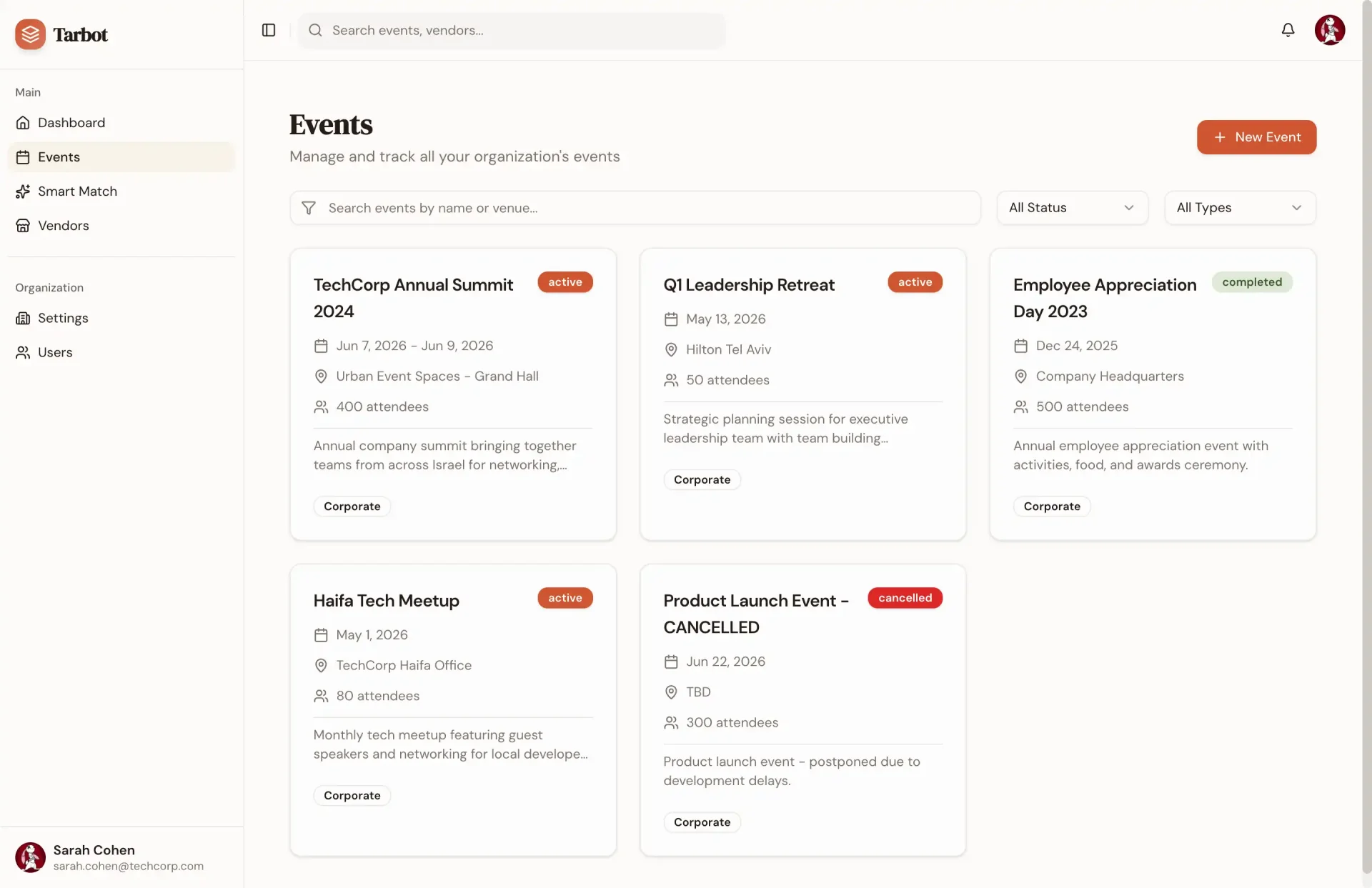
01Tarbot is a portmanteau of the Hebrew words for culture and bot, which hints at the size of the thing. The platform they came to us to build is two businesses running inside one product: a B2B marketplace connecting institutional event producers to vetted service providers - caterers, logistics, venues, content, security - and a project-management control tower that sits on top of every match, handling budget, compliance, documentation, and supervisor oversight across every event those producers run.
Across web, mobile, and a WhatsApp assistant that drives the whole thing from inside a chat, the scope the day we started was the scope the day we handed it over. Nothing cut.
Where the earlier build came apart
02Tarbot had already tried. The first run through a generative-platform build ate somewhere around a hundred thousand dollars and never got to something anyone could operate on. The work kept landing at almost working - a dashboard that rendered until the calendar endpoint changed, a WhatsApp flow that shipped until the Stripe dependency shifted underneath it. Every drift meant another month of the actual business sitting idle.
By the time the Tarbot team found us, the constraint wasn't cost. It was the calendar. Every month the product wasn't shipping, the operation wasn't running.
Module by module
03The heart of the platform is the AI Smart Match engine. A producer describes the event in natural language - "Company toast for 200 people in October, budget 50k" - and the system returns the top three to five vendors, ranked on availability, location, pricing tier, and past performance. One-click generation of the initial event Gantt and a budget estimate for the event type. The AI auto-dispatches the brief to the top two or three matches; the producer still has the full ranked list to reach deeper into manually.
The Producer Dashboard is where the event gets run. Real-time budget tracker - allocated, committed, remaining - updated the instant a quote is approved or an invoice uploaded. A document vault with red, yellow, and green compliance indicators and automatic expiry alerts. AI-generated checklists that adapt to the event type (outdoor events add a safety-engineer approval; the system doesn't let the event ship without it). A read-only Share View for supervisors who need transparency without edit rights.
The Vendor Portal is the other side of the marketplace. A smart calendar that prevents double-bookings at the source, not at reconciliation. Opportunity management for the AI-dispatched briefs. A compliance profile - insurance, licenses, service packages, pricing tiers - that a vendor maintains once and reuses across every event they take.
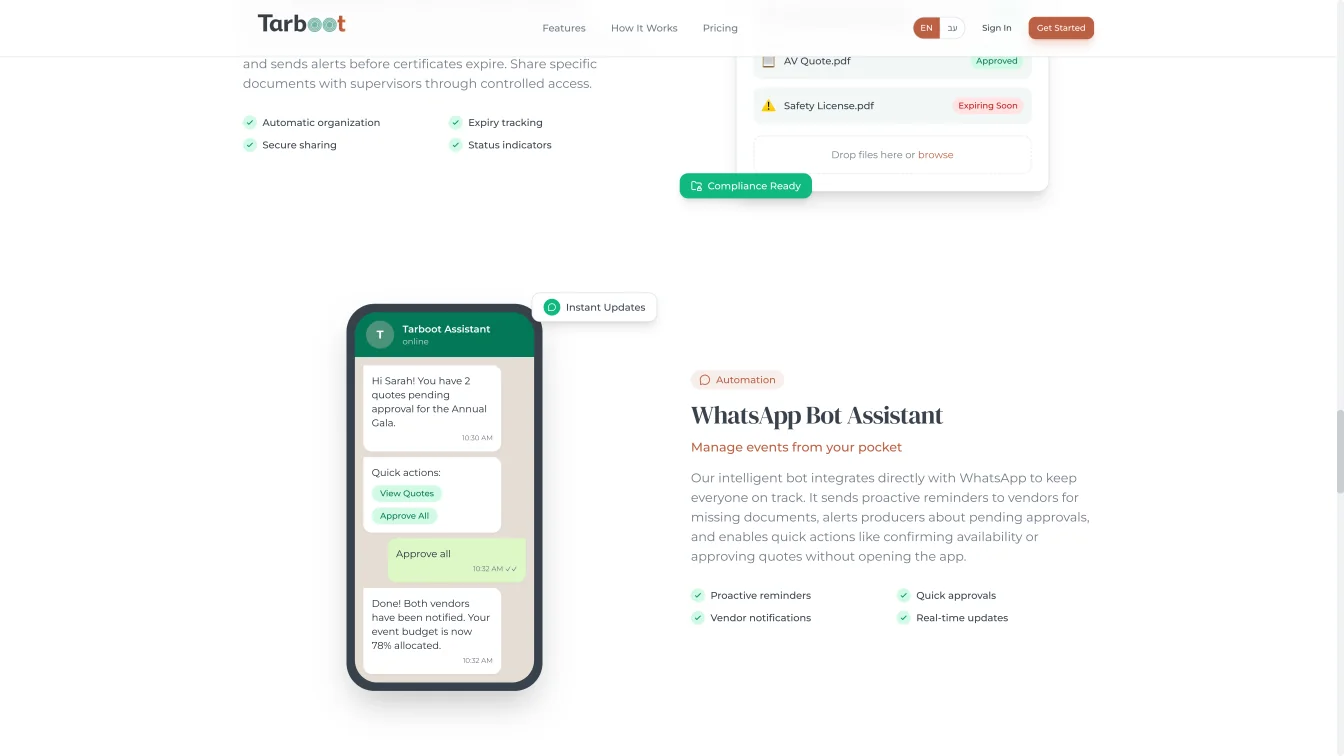
The WhatsApp assistant is how any of it stays in motion. Proactive reminders - "please upload your insurance renewal", "three quotes are waiting on your approval" - land on WhatsApp, which is where the actual work already happens. Quick actions - confirm availability, approve a quote, respond to a brief - complete inside the chat. Most of the time, nobody opens the app.
Underneath: Stripe-integrated payments with a transparent 8% marketplace commission flowing end-to-end from quote approval through vendor invoicing to reconciliation against the event budget. Multi-method auth across email, Google, Facebook, phone OTP. Trilingual - English, Hebrew, Arabic - with right-to-left rendering maintained across every screen, including the bot. Hierarchical accounts for operators running multiple regional branches under a parent organization. Camera-based document scanning, geolocation for vendor proximity, voice-search for the producer who is already on-site. Offline-capable PWA, because the venues where this gets used treat stable WiFi as a luxury good.
Running it now
04The Tarbot team is running their operation on it. Vendors are onboarded. Briefs are coming in and being matched. Quotes move through WhatsApp. Invoices reconcile inside the platform. Money moves through Stripe. The product they had been trying to get out the door is the product they are running the business out of.
We really love the platform and the way it's built. We have big, big ideas for what we want to create with it.
The shape that doesn't come out of a prompt
05A multi-sided marketplace, a payments layer, an AI matching engine, a WhatsApp bot, a compliance system, and a right-to-left tri-lingual UI - shipped as one product that runs together - is the specific shape generative tools don't hold. They close the first sixty percent fast and fall apart on the dependencies. Tarbot is the argument for the rest.
Co-founder and CTO of Creatr, building DeepBuild: the system that ships production web apps in 24 hours. Prince's open-source WhatsApp userbot, BotsApp, earned 5.5k GitHub stars and 1.3k forks during his college years. He later ran a solo freelance engineering practice to $100K in revenue before co-founding Creatr.