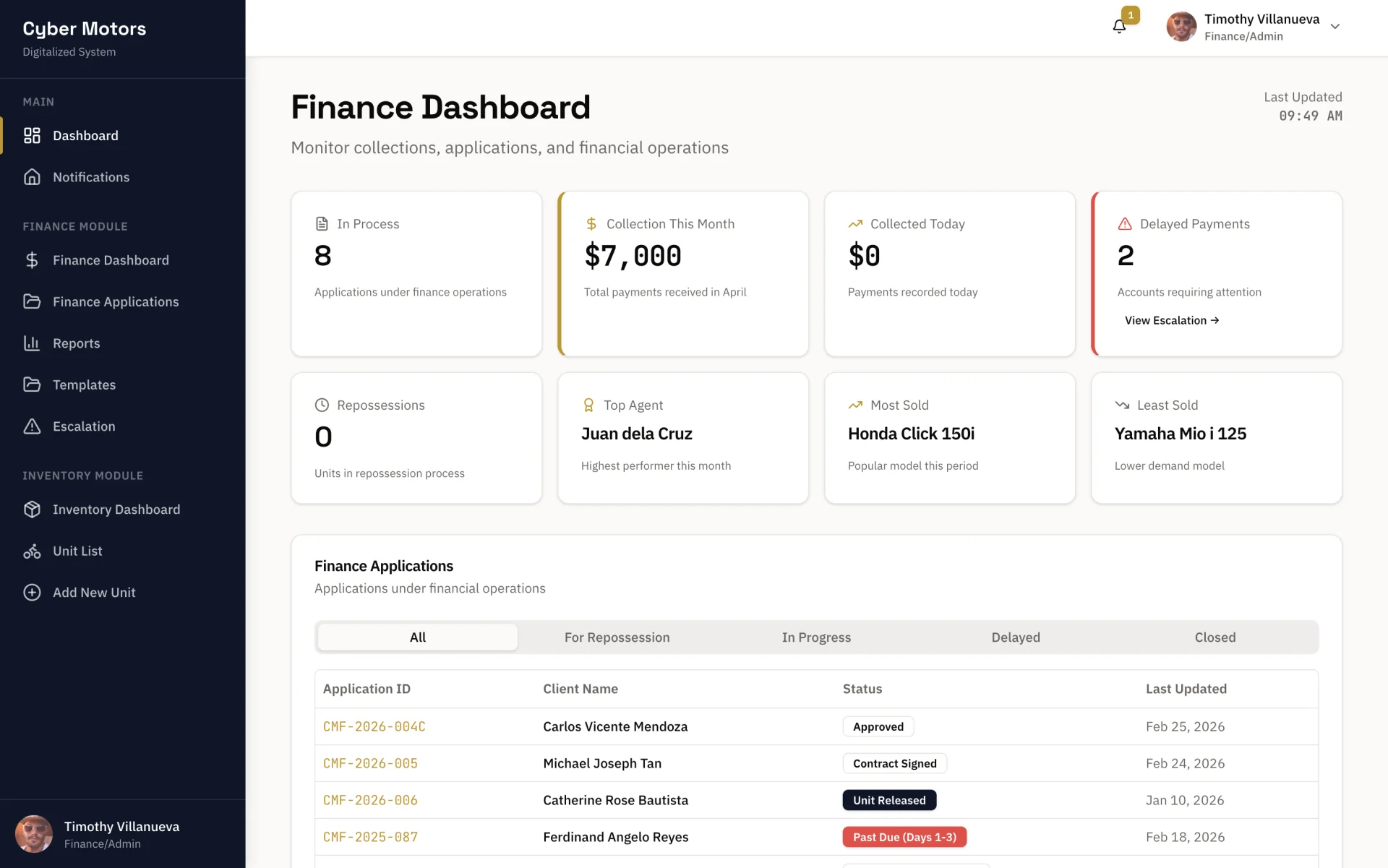
What the eight roles were actually costing
01Every loan moved through eight roles - Sales Agent, CI Handler, Branch Manager, Secretary, Finance Admin, Cashier, Owner, System Admin - with every handoff happening over Messenger or a phone call. A CI Handler would finish an investigation and ping the Branch Manager, who needed the Secretary, who needed the Owner for final approval. Each step created a gap where an application sat unactioned, a document went unchased, and nobody had a view of where it was sitting. Approval times of five to seven days were routine.
There was no deduplication of applicants. The same borrower could submit under slightly varied personal details and get through to approval while a previous defaulted loan sat open elsewhere in the spreadsheet. Collections ran weekly - a collector reviewed a sheet on Fridays, and if a payment was overdue by Thursday it wouldn't be escalated until the following week. Forty-five-day delays weren't exceptional.
The platform: workflow plus three agents
02The foreground is a structured multi-stage workflow moving every loan from submission through CI investigation, through dual-panel management review (Branch Manager and Secretary simultaneously), to Owner final approval. Each transition is automated; each role sees exactly what needs their action. Approval now runs in hours rather than days.
The background is where the real shift is. Three autonomous agents run continuously - doing the rule-enforcement the humans used to have to track by hand, and flagging only what requires judgement.
AGENT-003 · Duplicate detection. Fires immediately on every new application. Checks government ID against exact match, normalises name and date of birth for fuzzy comparison, validates contact number - all against a rolling six-month window. A duplicate gets flagged before any CI Handler opens the file. The stream of fraud that used to slip through stopped on day one.
AGENT-002 · Document follow-up. Runs daily, scanning for overdue Tier 2 document submissions. Past the fourteen-day threshold the application moves to DOCUMENT_HOLD - which triggers a hard block on Owner approval until the documents resolve. The miss rate dropped from substantial to near-zero.
AGENT-001 · Collections escalation. Runs hourly. Moves delinquent accounts through escalation levels automatically - CURRENT → PAST_DUE → LATE_NOTICE → PRE_REPOSSESSION → FOR_REPOSSESSION - with role-specific notifications at every threshold. Collections staff don't review a spreadsheet once a week; the system tells the right person about the right account the moment it crosses a bracket.
The ledger underneath
03The payment ledger is method-agnostic - cash, bank transfer, GCash, PayMaya, and check all handled, with webhook readiness for future gateway integration. Every transaction carries the full audit trail required for Philippine seven-year financial record retention.
Compliance architecture is built for that obligation, not retrofitted for it. There are no hard deletes anywhere in the system - every record carries a soft-delete field. Every agent action is attributed to SYSTEM_AGENT in the event log. A full audit trail exists for every decision the platform makes, human or machine.
Running the books now
04Approvals move. Duplicates don't get through. Documents don't go missing. Collections don't wait for Friday. The operation still runs with the same eight roles - they're just not doing the tracking the agents are now doing on their behalf.
The agentic programming features have made a real difference to how we run the operation. I appreciate the continuous updates and the team's support - with Creatr, I know we can deliver what we need.
Why this shape requires real software
05Three agents, an eight-role workflow, a method-agnostic ledger, and a soft-delete-everywhere audit layer - coordinated against a specific national regulation - is not a shape generative tools ship. The compliance is the product.
Co-founder and CTO of Creatr, building DeepBuild: the system that ships production web apps in 24 hours. Prince's open-source WhatsApp userbot, BotsApp, earned 5.5k GitHub stars and 1.3k forks during his college years. He later ran a solo freelance engineering practice to $100K in revenue before co-founding Creatr.